

On this page
AI is changing the way people search, find information and discover businesses. But rather than making websites obsolete, could it actually make them more important than ever?
It's a fair question, particularly when you look at what's happening to Google search. For years, businesses have invested in websites, search engine optimisation (SEO) and content with one main objective: getting more people to visit their website. More traffic meant more opportunities to generate enquiries, win customers and grow the business. But things are changing, and changing quickly.
Google is increasingly answering people's questions directly within its search results. AI Overviews have become a familiar part of the experience, while tools like ChatGPT are changing how people research products, find services and make decisions. And here's the thing: people were never really going to Google to find websites. They were going there to find answers. Now, increasingly, they're getting those answers without needing to click through to a website at all.
So where does that leave businesses that have spent years investing in their online presence? I actually think there's a huge opportunity here, particularly for businesses that have invested in building useful, informative websites that genuinely demonstrate their knowledge and expertise.
At Dzines Digital, we're already seeing the benefits of this approach. Websites we've spent years developing are appearing prominently in Google's AI-generated answers, sometimes with business descriptions, photographs, customer ratings and direct links to call the company.
That's why I think the question isn't whether websites are still worth having in 2027. It's whether businesses understand what their websites need to do in 2027. Because I believe a good website could become more valuable than ever.
Google is changing, but its purpose hasn't
Google has always had one fundamental job: to provide the most useful answer to whatever someone is searching for. Historically, it did that by giving us a list of websites. You searched for something, Google presented a series of links, and you clicked through to whichever result looked most promising.
Of course, it was never quite that straightforward. Over the years, SEO became an industry in its own right. Businesses competed for rankings, agencies developed techniques to influence those rankings, and Google's algorithms constantly evolved to try to stay ahead.
And let's be fair, the website sitting at number one wasn't always the one providing the best information. Sometimes it was simply the website with the biggest SEO budget, the strongest backlink profile or the most effective optimisation strategy. We've all experienced searching for something on Google, clicking through several results and still struggling to find a straightforward answer.
That's not to say SEO is a bad thing. Far from it. Good SEO has always involved making websites easier to understand, navigate and discover. But there's a difference between genuinely improving a website and simply trying to influence where it appears in search results.
Google has spent years trying to improve the quality of those results, and I think AI represents another significant step towards what Google has always wanted to achieve: providing the best possible answer.
Rather than simply pointing you towards a website that might contain the information, Google can now attempt to answer your question directly, drawing on information from multiple sources. If you're searching for something straightforward, that can be incredibly useful. Why visit three websites to find an answer when Google can summarise the information for you?
Of course, AI isn't perfect. It can make mistakes, misunderstand information and still be influenced by the quality of the sources it uses. I certainly wouldn't suggest that AI-generated answers are automatically better than traditional search results. But the direction of travel is clear, and for the person searching, the experience can be considerably more convenient.
For businesses, it means the way they get discovered is changing.
Search visibility is evolving
There's no getting away from it. AI-powered search is changing how people interact with search results. Research published by Pew Research Center in 2025 found that Google users clicked on traditional search results in just 8% of visits where an AI summary appeared, compared with 15% of visits without one.
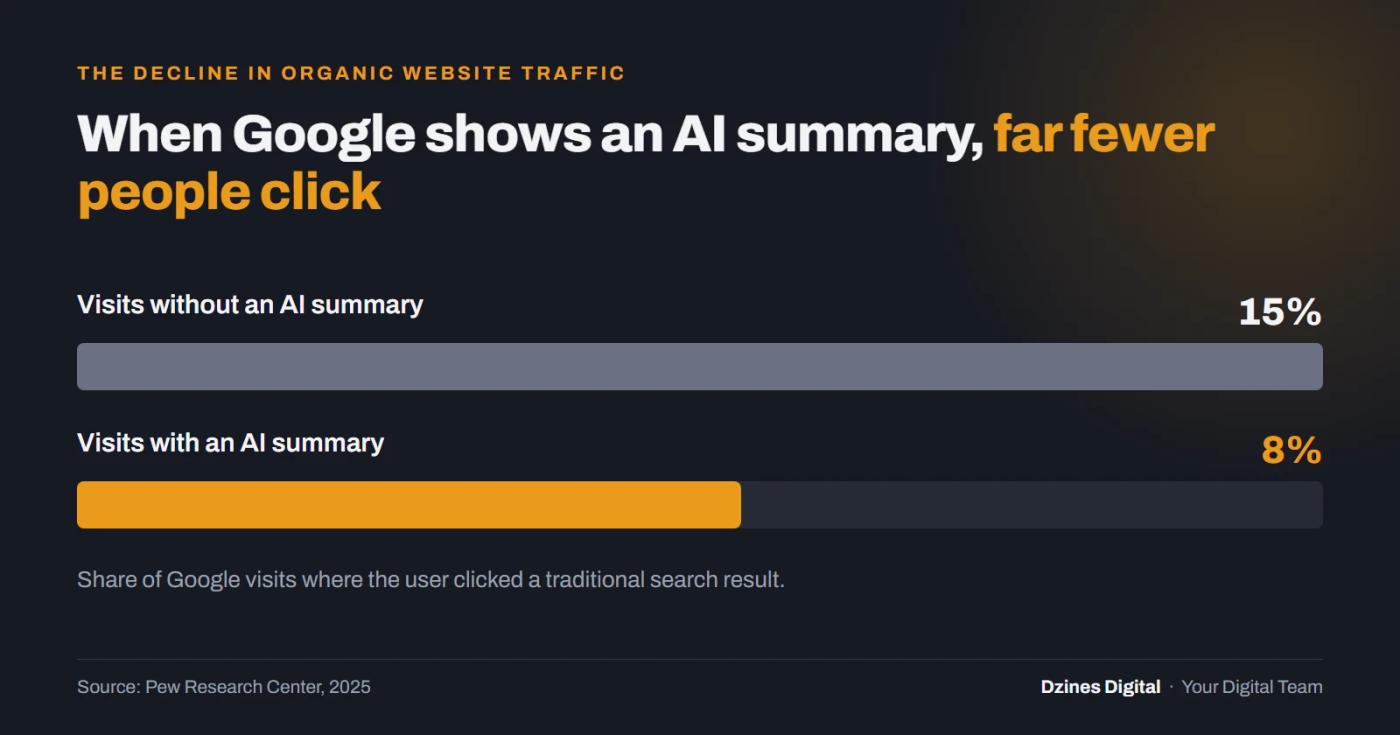
That's a significant difference, and it raises an interesting question about how we measure online success.
For years, website traffic has been one of the headline figures in almost every SEO report. More visitors generally meant things were moving in the right direction, while fewer visitors could suggest something wasn't working. But I've never believed that traffic alone tells you very much about how successfully a website is supporting a business.
You could have 10,000 people visiting your website every month, but if none of them enquire, buy anything or take the next step, what have you actually achieved? Equally, you could have 1,000 visitors, with a much higher proportion becoming customers. I know which I'd prefer.
As search continues to evolve, businesses need to look beyond traditional traffic figures and consider the wider picture. How often is their business being discovered? Are they appearing in relevant AI-generated answers? Are people getting in touch, requesting quotations and becoming customers?
Website visits still matter, of course, but they're increasingly just one part of the story.
More traffic doesn't always mean more business
One of the things we've always focused on at Dzines Digital is what happens after someone visits a website. Attracting visitors is important, but ultimately, businesses need those visitors to become enquiries and customers.
We recently had a conversation with one of our clients, Aquasoft, a water softener company, who told us they'd enjoyed two consecutive record-breaking months for their business. Naturally, we were delighted to hear that, particularly as we've been working on improving their website, content and user experience.
What's interesting is that their website hasn't needed record visitor numbers to achieve those results. When we compared October 2025 with October 2026, we found that recorded customer interactions had increased despite a reduction in overall website visitors.
It's a good illustration of something I've believed for a long time: the success of a website shouldn't be measured by traffic alone. It's about attracting relevant visitors, giving them the confidence to get in touch and making that process as straightforward as possible.
As search continues to change, I think that focus on genuine business outcomes is going to become even more important.
From being ranked to being recommended
This is probably one of the most exciting developments we're seeing in search at the moment.
Traditionally, if you wanted your business to be found on Google, you worked towards appearing as high as possible in the organic results. If you reached the first page, great. If you reached the top three, even better.
But AI-powered search is creating another opportunity. Rather than simply appearing as a link in a list of websites, your business can now be presented as part of the answer itself.
We're seeing this with CDDL Recycling, a commercial waste management company in Kent that we've worked with for several years.
During that time, we've developed a substantial amount of content for their website, covering commercial waste collections, recycling services, hazardous waste, legislation and the different types of waste businesses need to manage. It's been a steady process of building useful information around the services they provide and the questions their customers ask.
In a recent three-month period, their website generated approximately 27,000 impressions in Google's generative AI search features, across 206 search phrases.
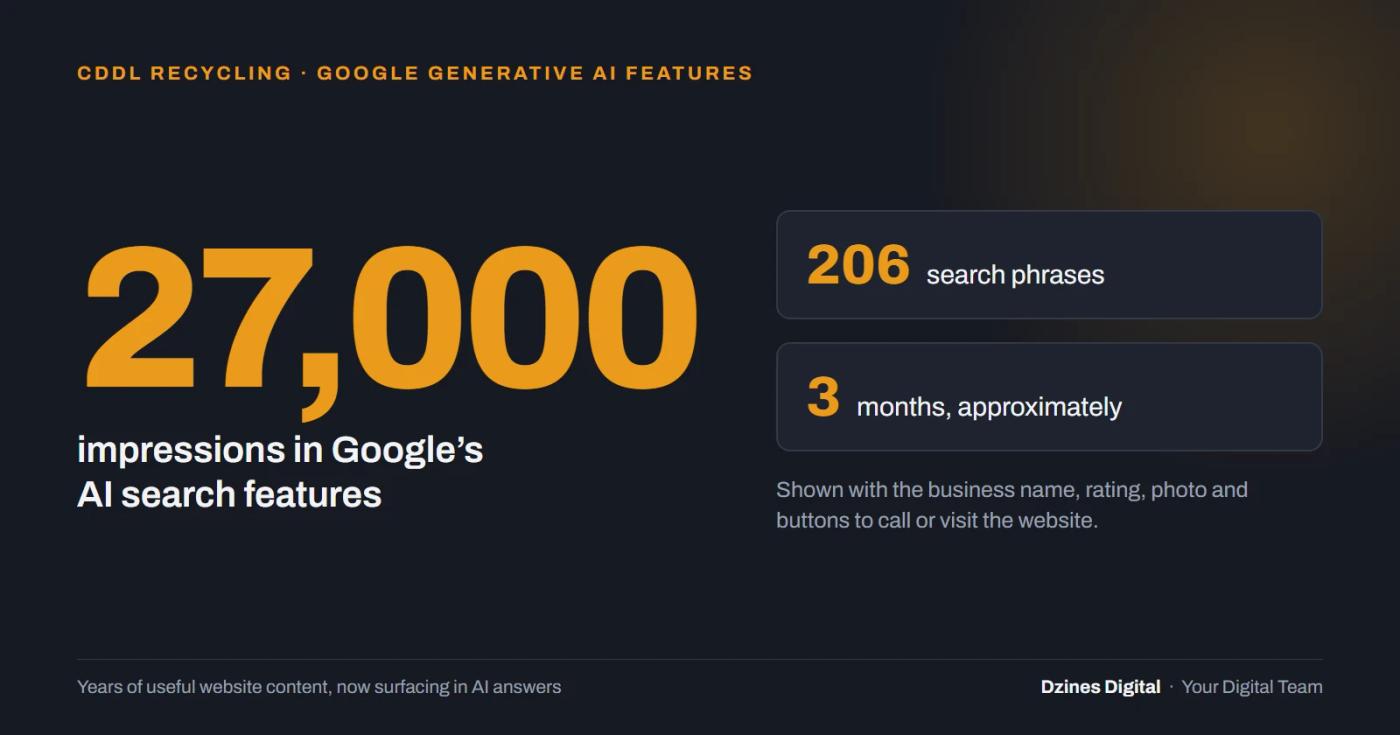
But it's not just the number of appearances that interests me. It's how Google is presenting the business.
Search for phrases such as "hazardous waste removal Kent", "paper waste Kent" or "commercial bin collections Kent", and we've seen Google feature CDDL directly within its AI-generated answers. In some cases, Google displays the business name, description, customer rating, photograph and buttons to call or visit the website.
On certain searches, these recommendations appear prominently above the traditional organic results, sometimes before users even reach the familiar map listings.
Think about what that means for a moment.
Someone looking for a commercial waste company can search Google, see CDDL presented as a relevant provider, understand what they offer and potentially call them directly from the search results. They might never visit the website, but the information we've helped develop on that website is contributing to the business being discovered at precisely the moment a potential customer is looking for its services.
That's a significant change. Instead of competing solely for a position in a list of websites, businesses have opportunities to be featured within the information Google presents to its users.
Of course, being included in an AI-generated answer isn't the same as Google personally endorsing a company, and these results can change from one search to another. But from a visibility perspective, it's an exciting development.
Your website is no longer just somewhere customers go. It's also a source of information that helps other platforms understand, discover and recommend your business.
Good content is becoming more important, not less
One of the things I've always believed is that a good business website should do more than describe a company's services. It should demonstrate knowledge, answer questions, explain processes, address concerns and help potential customers make informed decisions.
That's why we spend so much time developing content with our clients. And what's particularly interesting is that content we've been building over several years is now becoming valuable in ways that weren't necessarily part of the original plan.
Take CDDL Recycling again. We didn't spend years developing their website specifically to appear in AI Overviews. Those features weren't even available when much of the content was created. We were building a comprehensive resource to help customers understand waste management services, answer their questions and improve the website's visibility in traditional search.
Now that same content is helping the business appear in AI-generated answers.
And we're seeing similar patterns across other industries.
Across four client websites, we've recently recorded more than 122,000 impressions in Google's generative AI search features over approximately three months. For Price Lilford, a firm of property surveyors, an article explaining what type of survey a bank might require generated more than 4,000 impressions. For SBB Scaffolding, articles explaining subjects such as bridge scaffolding and working in high winds are appearing in AI-powered search results.
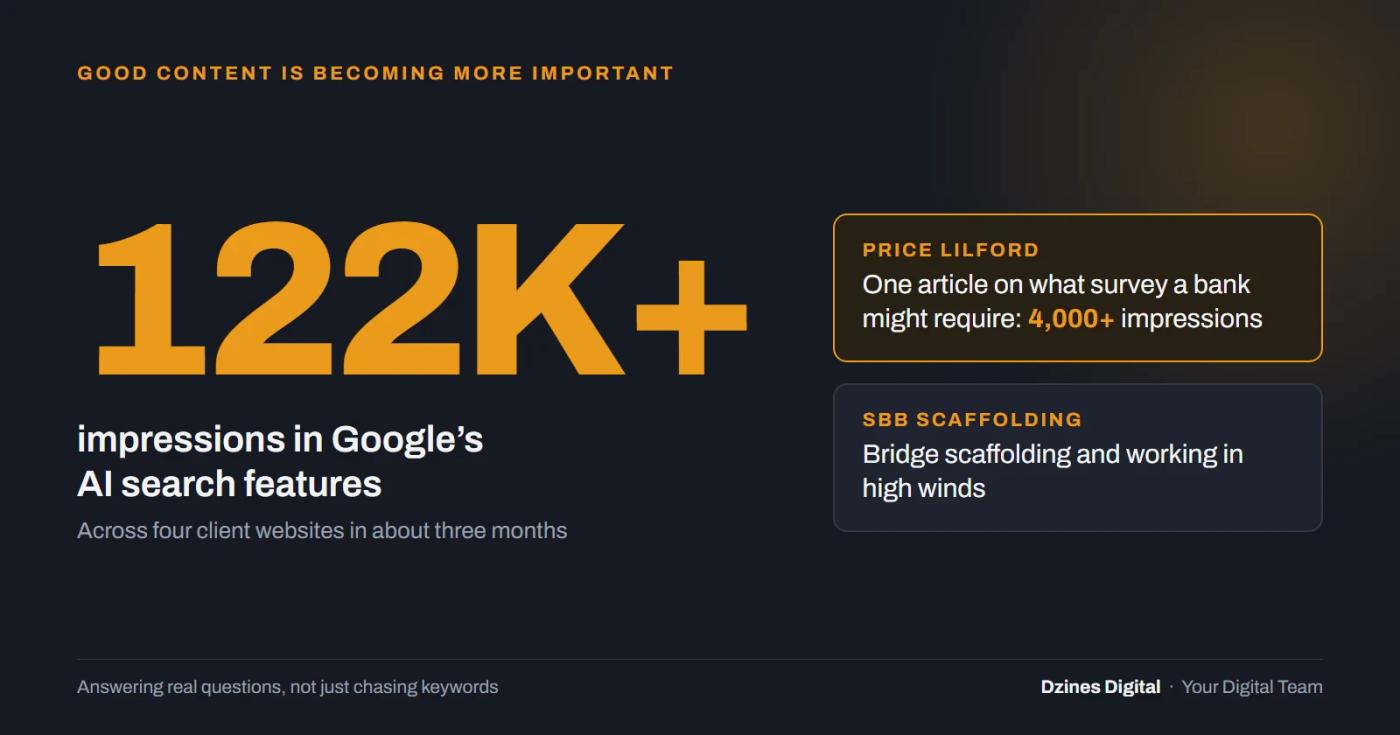
These aren't necessarily pages designed to sell a service directly. They're pieces of content that answer genuine questions people have, and that's important.
For years, businesses have been encouraged to create content around keywords. Find a phrase people search for, build a page around it and try to rank. Keywords still matter, of course, but I think the bigger opportunity now is to think about topics rather than individual search phrases.
If you're a property surveyor, don't just have a page saying you provide building surveys. Explain the different surveys, when they're needed, what they involve, how much they might cost and what happens when problems are discovered. If you're a waste management company, explain the different waste streams, collection options, legal responsibilities and practical challenges businesses face.
Over time, you build a genuinely useful resource around your area of expertise. Not a collection of pages written purely for search engines, but a website that demonstrates a thorough understanding of what your business does.
That doesn't guarantee you'll appear in an AI answer, and AI-generated results certainly aren't immune to mistakes or poor-quality information. But it gives search engines and AI systems more useful, relevant material from which to understand your business and its expertise.
And importantly, it gives your customers better information too.
I think that's one of the most encouraging aspects of where search is heading. Businesses that have invested in genuinely useful content are finding that their websites can support visibility across more channels than ever before.
What about ChatGPT and the other AI platforms?
Google is still enormously important, but it isn't the only place people are searching. More people are turning to ChatGPT and other AI assistants to research products, compare services, find recommendations and ask questions that might previously have gone straight into Google.
We're already seeing referrals from ChatGPT appearing in website analytics. At the moment, those visits are generally relatively small compared with Google, but I don't think website referrals tell the whole story here either. Just as with Google's AI Overviews, someone might discover your business through an AI-generated recommendation without clicking through to your website.
And these platforms are developing quickly.
OpenAI has begun introducing business profiles through its Business Hub, giving businesses opportunities to manage information about themselves within ChatGPT. We're also beginning to see AI platforms explore advertising, sponsored placements and other commercial opportunities.
I think this is going to be a particularly interesting area to watch throughout 2027.
We've spent years helping businesses compete for visibility on Google, whether through organic search, local search or paid advertising. Now we're potentially moving towards a world where businesses also need to consider how they're represented across several different AI platforms.
Each may have its own approach to discovering businesses, presenting recommendations and offering commercial opportunities. And while advertising may become another way to reach potential customers, it shouldn't be confused with earning visibility through the quality and relevance of your information.
But there's something worth remembering. All these platforms need information about businesses. They need to understand what you do, where you operate, which services you provide and why someone might choose you.
That information can come from several places, including business profiles, reviews, directories and third-party websites. But your own website remains one of the most important places where you can explain your business in detail and maintain control over the information you publish.
If AI is increasingly helping people discover businesses, surely having a comprehensive, accurate and well-maintained website becomes more important, not less?
Does website design still matter?
Absolutely. But perhaps not in the way some people think.
I've been designing websites for years, and one thing I've learned is that a beautiful website doesn't automatically make it a successful one. Of course, how a website looks matters. It needs to create the right impression, reflect the business and give visitors confidence. But good design is about much more than colours, animations and attractive layouts.
People generally aren't visiting your website because they want to be impressed by your web design. They're visiting because they're looking for something. They have a question, a problem to solve, a product to buy or a service they need.
What matters is the impression they leave with.
Did they find what they were looking for? Did they understand what your business offers? Do they trust you? And perhaps most importantly, was it easy for them to take the next step?
That's where good design and user experience come together. A well-designed website makes information easy to find, easy to read and easy to understand. It uses layout, typography, photography and content to communicate clearly, rather than simply trying to look impressive.
And if fewer people are visiting websites as AI search develops, it makes sense that we should be doing everything possible to make those visits count.
Clear navigation, well-structured content, genuine photography, customer reviews and straightforward ways to get in touch all play a part. A website shouldn't simply look impressive. It should leave the right impression and make it easy for someone to take action.
Increasingly, it also needs to present information in a way that search engines and AI tools can understand. The two objectives aren't mutually exclusive. Good structure, clear headings and useful content benefit both people and machines.
So what should businesses be doing differently in 2027?
I don't think businesses need to throw away everything they've learned about websites and SEO. Quite the opposite. Many of the things that have always made a good website valuable are becoming even more important.
Start by understanding your customers. What questions are they asking? What problems are they trying to solve? What information do they need before they're ready to make a decision? Then make sure your website answers those questions properly, not with hundreds of thin pages created simply to target slightly different keywords, but with useful, well-considered content that demonstrates your understanding of your industry.
And think about the bigger picture. Rather than treating every service page or blog post as an isolated piece of content, consider how everything fits together. Does your website provide a comprehensive picture of what your business does? Does it explain your expertise, answer common questions and help people understand why they might choose you?
Keep your business information accurate and consistent. Make sure your services, locations, contact details and expertise are clearly explained. Pay attention to your Google Business Profile, customer reviews and the other places your business appears online. Your website is important, but it doesn't exist in isolation.
Perhaps most importantly, start thinking differently about how you measure success. Organic rankings and website traffic still matter, but they shouldn't be the only numbers you're looking at. Look at enquiries, phone calls, conversions and the quality of the opportunities your website generates. Monitor your visibility in AI-powered search where you can, and try to understand how customers are actually discovering your business.
The customer journey is becoming less straightforward, and our reporting needs to reflect that.
The future of websites is bright
So, are websites still worth it in 2027? Absolutely. In fact, I'm more optimistic about the opportunities ahead than I have been for some time.
For years, the website has been treated as the final destination for online marketing. Everything was designed to bring people back to it. Now, your website increasingly has another job. It's helping search engines, AI platforms and potential customers understand your business, even when those customers don't visit it directly.
And that makes the quality of the information you publish incredibly important.
What we're seeing across the businesses we work with is encouraging. Content developed over several years is now helping companies appear in AI-generated answers, gain visibility for relevant searches and reach potential customers in new ways.
To me, that reinforces something we've believed for a long time. A successful website isn't just about how it looks or where it ranks. It's about understanding a business, understanding its customers and creating something genuinely useful that helps bring the two together.
There will undoubtedly be more changes ahead. Search will continue to evolve, AI platforms will introduce new features, and the way businesses compete for visibility will change with them. But I don't see that as a reason to stop investing in websites.
I see it as a reason to invest in better ones.
Websites with well-structured information, comprehensive content, genuine expertise and a good user experience will continue to play an important role in how businesses are discovered and how customers make decisions.
Fewer people might visit your website in 2027. But that doesn't mean your website will be doing less work. In fact, if you get it right, it could be doing more than ever.
Get your website working harder
At Dzines Digital, Helen and I help businesses build websites that do more than look good. From web design and user experience to SEO and content, we focus on helping businesses get found, generate enquiries and grow.
Dzines Digital — Your Digital Team for Growth.
Want to know where your site stands?
Get a straight-talking review of your digital presence.
Talk to us →